Welcome to Schwerin. Let us introduce Schwerin… Part 2.

In part 1, we introduced you to a part of Schwerin’s history between 1940 and 2016. This time, we’ll look at what happened after those years and how it has influenced the city we see today.
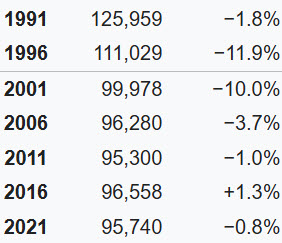
As you’ve seen, the population figures collapsed after the fall of the Berlin Wall, but then suddenly in 2016, there’s growth? It’s not a lot, but still…
And now there are more recent figures available. Compared to 2021, when Schwerin had 95,740 residents, the population has grown by about 3.13% in 2023. How did that happen all of a sudden?
In 2015, there was a massive influx of refugees and migrants to Europe during the refugee crisis that year. On August 31, 2015, Angela Merkel delivered her famous “Wir schaffen das” speech, emphasizing that Germany would face the challenges of integrating and housing refugees. While it was a powerful statement, it also sparked a lot of criticism and controversy, both domestically and internationally. Opponents saw it as an underestimation of the logistical and social problems, while supporters viewed it as an act of moral leadership.
And Schwerin? There were thousands of vacant apartments. The exodus of the local population continued, but the influx of refugees and migrants increased. This led to a huge imbalance in the Plattenbau neighborhoods…
As for the Germans who still lived there? They were not happy, and many are still far from pleased. They were already living in a bleak city with no work, their healthcare—which had been free in the GDR—was now unaffordable without a job (that’s their perspective), and the homes they had been given cheaply in the DDR were suddenly quite expensive in the new era… and that creates tension. A lot of it. Where do you notice it? Everywhere. Pay attention:
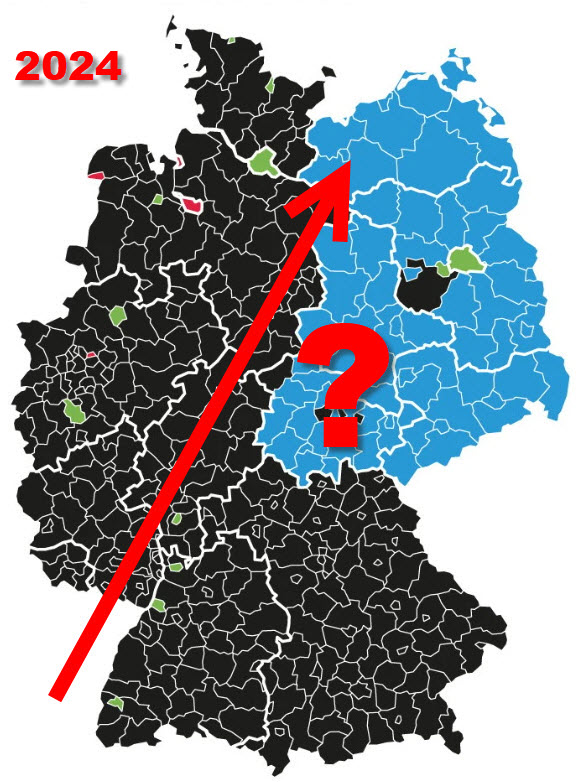
You can literally see the former East Germany on the map when you look at the election results from 2024. While in the West, “left” is the dominant vote, in the East, the right-wing vote is notably stronger. This right-wing movement is known for its nationalist, populist stances, particularly on immigration, EU skepticism, and traditional values.
The next map isn’t a map of old East and West Germany, no, this shows how people voted in 2024. You can literally see the former East Germany, even though that country no longer officially exists…
Blue: AfD
Black: CDU/CSU
And Schwerin, where the red arrow points, is located in the blue/right-wing area.
If you look further, you’ll also see Berlin, right in the middle of a “right/blue” area, with a black/left spot standing out—Berlin, where political power is also centered.
Can you feel the tension building in today’s Schwerin?
In London, there are neighborhoods like Newham, and in New York you have neighborhoods like Harlem or The Bronx, where the socioeconomic conditions lead to tensions and challenges in integration and social mobility. In Schwerin, there isn’t just one such neighborhood, but several… With Germans who unfortunately often belong to the “lower social” population on one side, and on the other side, thousands of migrants… and they now live, together, in those neighborhoods.
The unemployment rate in Schwerin is currently about 7.6% (compared to 3.7% in the Netherlands). This is relatively high compared to the German national average (5.9%), which is significantly lower. Mecklenburg-Vorpommern, the state where Schwerin is located, generally has a higher unemployment rate, with Schwerin being one of the cities with an above-average percentage of unemployed people.
In East Germany, employees still earn less on average than in West Germany. Wage differences range from 20-30%, depending on the sector and type of work. For instance, skilled workers in the west earn an average of €46,835 per year, while in the east, this figure is around €37,373. These disparities are partly due to a lower concentration of large companies in the east and a focus on smaller, less profitable businesses.
According to the official Crime Report of Germany from 2007, Schwerin was the only German city with a crime rate of more than 17,000 crimes per 100,000 inhabitants. This made the city the number one on the list of the most dangerous cities in Germany.
Encountering someone with “symbols from the not so good past” is not uncommon, the AfD (right-wing political party) flag is regularly seen, unemployment is high, there are many migrants, and not everyone is well integrated into the local society, with all the consequences that follow.
The feelings of former GDR residents about all this are unfortunately often ignored. “It’s probably not that bad, right?” They’re often called “Ossis,” which is far from a term of endearment. Another term, “Jammerossis,” (wailing eastern Germans) is sometimes used—a mocking label describing the stereotype that East Germans complain about the changes since German reunification. However, this negative term is far from appreciated—in fact, it’s the opposite.
Whether or not this “wailing” is justified is beside the point, but the feelings are there, and they’re anything but trivial. And that’s a significant issue. We often say, “perception is reality.” Their feelings are very real, and dismissing them as “not true” or mocking them only reinforces those feelings. We fully acknowledge their perception as their reality. Their feelings are their truth, and it’s something we must address and can work with.
Can you feel the tension? Welcome to Schwerin. There’s more than enough to do… In part 3 we continue to introduce Schwerin to you all.
Sources:
- https://en.wikipedia.org/wiki/Schwerin
- https://nl.wikipedia.org/wiki/Conferentie_van_Jalta
- https://de.wikipedia.org/wiki/Land_Mecklenburg
- https://www.regierung-mv.de
- https://www.bild.de/politik/inland/
- https://duitslandinstituut.nl/artikel/20261/studie-nog-steeds-grote-loonverschillen-tussen-oost-en-west
- https://duitslandinstituut.nl/artikel/30546/studie-verschillen-tussen-oost-en-west-duitsland-blijven-zeer-groot
- https://duitslandinstituut.nl/artikel/12241/Werklossheidsverschil-Oost-en-West-nu-maar-35-procent
- The residents of Schwerin we have personally spoken to.