Time, Money, and Talents: A Lesson in Wise, Faithful Choices

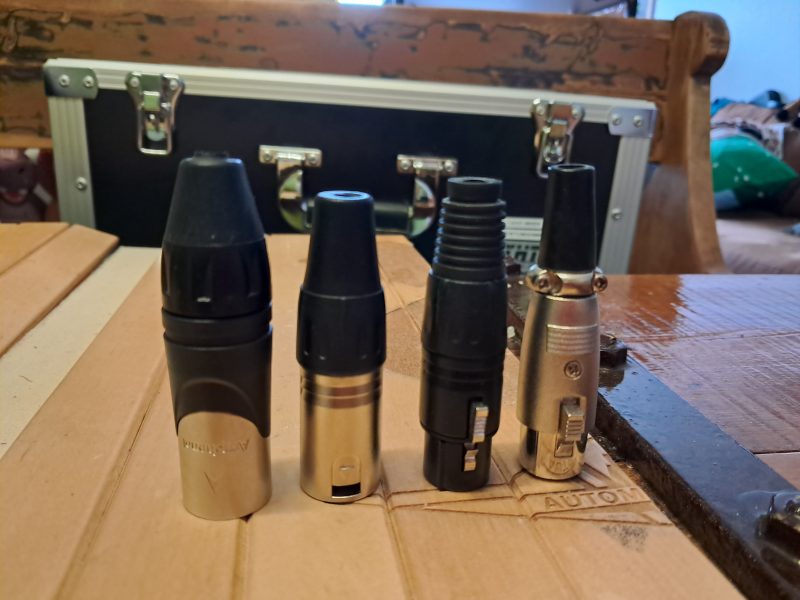
A few years ago, at an organisation we have occasional contact with, there were two short cables that they still wanted to use themselves. It was not entirely clear whether they were DMX or audio cables (most likely DMX), and one of the two did not work properly sometimes(!).
The first thought was logical: remove the connectors, check them, solder them again, repair the cables and hope that would solve the problem. Because if there is a break in the cable, it still will not work.
But when I looked at the bigger picture for a moment, a question came up: are we actually being wise here?
A complete DMX cable of the same length, including connectors, costs €2.84.
The same length of cable without connectors costs €1.75.
The difference? Only €1.09 per cable.
To reuse the existing connectors, you spend approximately 30 minutes per cable: preparation, removing the old connectors, soldering, testing and cleaning up. For two cables, that means about one hour of work.
So: investing one hour to save €2.18.
At first glance, that seems economical. But when you look at the bigger picture, it actually becomes rather strange. We are willing to spend an hour of our life to save an amount that many people earn in just a few minutes.
When I suggested that it would be faster, simpler and more reliable to simply buy two new, complete cables, the response was that there was no budget for complete cables, only for loose cable. My decision was made quickly: I did not even start.
The response I received was: “Come on, it is only an hour of work for you, right? Why are you making such a big deal out of it?”
And that is exactly where the problem lies.
An hour is not “just an hour”. An hour is a piece of your life that you will never get back.
Volunteer work is valuable. It can make many things possible and save costs. But even as a volunteer, you are called to wisely handle what you have been given. Not only money, but also time, energy and talents.
The question is not only:
“How much money do we save?”
The better question is:
“Where can we use this time best?”
For example:
- A conversation with someone who is struggling and needs help: approximately one to one and a half hours. (we currently have a waiting list)
- Investing time in someone who is homeless and wants to be heard: half an hour to an hour.
- Helping a missionary who is on a waiting list for a retreat and needs restoration.
So the question becomes very practical: Is this something where my help is really needed? Is this a good investment of the time entrusted to me? Or is this something someone else can learn to do themselves and continue doing independently?
Because ultimately, we all only have a limited amount of time. What will you choose?
- Spend an hour resoldering a few cables to save a few euros?
- Or use that same hour to sit beside someone who needs help, attention or a conversation?
Because imagine someone comes to ask for help and I have to say: “Sorry, I do not have time right now. I am repairing a few connectors.”
The question is not whether soldering is useful work. Of course technical work can be important. The question is: is this, at this moment, the best way to use the time and talents God has given me?
The lesson is of course not about cables. It is about how we handle everything God gives us. How do you handle it?
The Bible teaches us that we are stewards of the things entrusted to us. Money is a talent. But so is time. So is energy. Every heartbeat is a gift, but we do not receive an unlimited amount of them.
Jesus tells us in Matthew 25:14–30 about the talents entrusted to people. The question is not how much someone receives, but what someone does with it. Do we use our talents for things that truly bear fruit? Or do we waste them on things that ultimately make little difference?
And this also applies to what we give to others. Giving a gift is beautiful. But it is good to also think: Can the other person really use this? Or are we giving someone something that may appear free, but ultimately costs more time, energy and money than it provides? Sometimes something that is free is not cheap at all. As Paul writes:
“And whatsoever ye do, do it heartily, as to the Lord, and not unto men;” (Colossians 3:23 KJV)
Give consciously. Work consciously. Spend consciously. Because sometimes the cheapest solution is ultimately the most expensive one.
Invest your time, money and energy where it truly produces fruit.