Poop shovel

Recently, someone asked me, completely seriously, whether I also removed my poop from my house with a little shovel.
When I replied: “Of course not”, I was immediately told that I therefore was not a real Christian and needed to change my life. No joke.
His reasoning was simple: if you say that you are a Christian, then you must also do everything that is written in the Bible. If you do not, then according to him, you should also remain silent about what others do or do not do.
It soon became clear that this was not really about a poop shovel at all. That was only the starting point for his actual argument.
I have to admit, I had to laugh. He was trying to use a Bible verse and then use it to defend his own position. It was quite a creative approach. From the way he presented it, I could tell he had already had this conversation many times before. Apparently, most Christians got stuck, came up with the familiar response: “That Old Testament no longer applies,” or simply walked away.
That is exactly why he was surprised when I stayed. We calmly looked together at the passage he was referring to.
Also you shall have a place outside the camp, where you may go out; and you shall have an implement among your equipment, and when you sit down outside, you shall dig with it and turn and cover your refuse. (Deuteronomy 23:12-13, NKJV)
At first glance, it is a striking law.
Do you do that? Go outside with a shovel?
Probably not.

His conclusion therefore seemed logical: “See? Those laws are outdated. We simply choose which rules we still follow and which ones we don’t.”
And honestly, I understand that reaction. Because if that were true, the Bible would indeed become a pick and choose book. This rule suits me, that one does not, so we simply leave it aside.
When I told him that I agreed with him on that point, the atmosphere changed. Because I also do not believe that we can simply remove parts of God’s Word.
So how should we understand this?
Jesus Himself gives the answer.
In Matthew, Jesus Himself says:
“Do not think that I came to destroy the Law or the Prophets. I did not come to destroy but to fulfill. For assuredly, I say to you, till heaven and earth pass away, one jot or one tittle will by no means pass from the law till all is fulfilled. Whoever therefore breaks one of the least of these commandments, and teaches men so, shall be called least in the kingdom of heaven; but whoever does and teaches them, he shall be called great in the kingdom of heaven.” (Matthew 5:17-19, NKJV)
Jesus does not say that the law disappears. On the contrary. He fulfills it and shows what God’s intention behind it truly is. Not even the smallest letter or stroke of the Law may simply disappear. God does not change. So when He gives a command, He never does so without a reason.
So… the poop shovel?
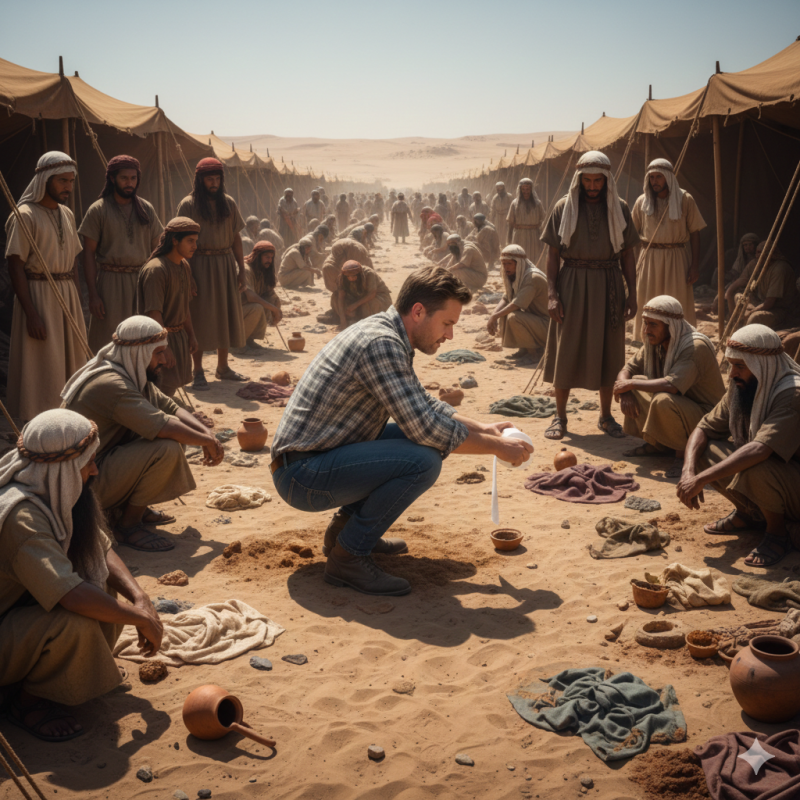
The context helps us tremendously: the Israelites in the wilderness.
Israel lived in a camp in the middle of the wilderness. No sewage system. No toilets. Without clear rules, diseases could spread rapidly.
The heart of this law is therefore not: “Always use a shovel.”
The heart of it is: take good care of yourself. Prevent disease. Protect the life God has given you.
Why did the Israelites need such specific, sometimes almost overly detailed laws, while today we often understand the underlying principles naturally?
Why did God have to command people, for example, to bury their excrement? Wasn’t that simply common sense?
The answer is not that the Israelites were less intelligent or that they lacked common sense. It goes much deeper than that: the way the Holy Spirit worked in people was completely(!) different in the Old Testament than after the coming of Christ. Pentecost had not yet happened.
After Pentecost, we see this new reality:
“And when He has come, He will convict the world of sin, and of righteousness, and of judgment.” (John 16:8, NKJV)
And Paul writes:
“Or do you not know that your body is the temple of the Holy Spirit who is in you, whom you have from God, and you are not your own?” (1 Corinthians 6:19, NKJV)
That is the great difference with the Old Testament. The Holy Spirit was certainly already present then, but with the coming of Christ and Pentecost, something new happened: God’s Spirit now permanently dwells in every believer. That is an enormous difference.
A Christian therefore does not live only by rules from the outside, but by God’s Spirit from within. The Holy Spirit convicts us of sin, teaches us to understand God’s will, and opens our eyes to what is right and wrong.
Without the work of the Holy Spirit, we often do not see things the way God sees them. Then we need clear instructions from the outside that tell us what is right and wrong. That is exactly why God gave Israel such specific laws, including the poop shovel.
With the coming of Christ and the indwelling of the Holy Spirit, the situation suddenly changes. The law is no longer only written on stone tablets outside of us, but God writes His will on the hearts of His children.
Not less obedience, but deeper obedience.
Not only knowing what God says, but also learning to understand why He says it.
More than just practical rules
Today we no longer have to dig little holes, but the purpose of that law is still the same: take care of the body God has given you. This concerns not only hygiene, but also nutrition, exercise, rest, and everything that influences body and mind.
This is exactly what Jesus continually does. He does not remove the law, but deepens it.
The Israelites could never keep God’s law perfectly. That is why Christ came. He fulfilled the law completely. Because of this, believers are not judged according to their own perfection, but according to His perfect righteousness.
The old laws have therefore not become worthless. They still point to God’s character and His intentions. Often, that intention goes even further than the literal words of the law.
Even with a poop shovel.
And that is exactly where our conversation really began.
Because if it is ultimately no longer about the shovel itself, but about the intention behind it, then the next question naturally arises:
How do I keep myself clean today?
Not only after going to the toilet, but also spiritually. Inside my mind.