Is Man Good or Evil? What Does the Bible Really Say? Jesus as a “Lens”

I regularly get questions like this:
“I read somewhere that God sees man as a sinner. That doesn’t fit at all with how I view people. How does that work, because I also don’t believe God is like that.”
Short answer:
According to the Bible, humans were originally good, but sin changed that. However, whoever trusts in Jesus is no longer seen by God as someone with faults, but as someone fully restored and truly good.
This is the short answer, but the full picture is MUCH richer. Let’s explain step by step what the Bible says, why half-truths are misleading, and what it means that Jesus serves as a “lens” through which we are seen.
Before going deeper, it’s important to clarify something that often goes wrong with these kinds of questions and answers:
Simply saying that man is evil, or simply saying that man is good, is both a half-truth. And a half-truth is not the truth; it’s misleading.
- If someone says, “Everyone is sinful” and stops there, they miss the restoration God offers.
- If someone says, “Everyone is good” and stops there, they deny the reality of the world and humanity.
To understand the full truth, both the questioner and the one answering must be willing to hear the whole story and actively seek it. Only then can the right answer be understood. Stopping halfway in answering—or in listening—doesn’t work.
Let’s now look at the full answer, not just one part of it:
1. Humans were originally created good
The Bible starts positively: humans are not bad, but good.
“God saw all that He had made, and behold, it was very good.” (Genesis 1:31, NASB)
God created humans with value, purpose, and beauty, to live in harmony with Him, themselves, others, and the world. This shows that the idea that humans are “naturally evil” is a half-truth; the whole story begins with goodness.
2. The world and humans unfortunately do not function perfectly
Look around: people suffer, relationships break, conflicts arise, and society doesn’t always function justly or well. Everyone notices that the world is not perfect. Denying that… I would love to, but it’s impossible. The world is not perfect, perhaps quite the opposite of perfect. Something about Adam, Eve, and an apple (Or was it a banana? We don’t know what kind of fruit it was…)
In the Bible, this is called “brokenness.” It may sound theological, but you recognize it immediately: it means that the world and humanity no longer function as God intended. The purpose of life and the world is not fully realized. The Bible describes it like this:
“There is none righteous, not even one; there is none who understands, there is none who seeks for God; all have turned aside, together they have become worthless; there is none who does good, not even one.” (Romans 3:10–12, NASB)
A little later in that chapter, it is confirmed again:
“For all have sinned and fall short of the glory of God.” (Romans 3:23, NASB)
Notice: mentioning sin is a diagnosis. It’s like a doctor diagnosing a disease: you are not condemned because the disease exists, but it shows that there is a problem that needs attention. That “disease” exists, and if you look around, you see it everywhere. Open a newspaper and misery confronts you. Unfortunately.
3. What does ‘sin’ actually mean?
In the Old Testament, sin is expressed with the Hebrew word חטא (chet), and in the New Testament with the Greek ἁμαρτία (hamartia). Both literally mean:
“to miss the mark”
Think of an archer who misses the target: it’s not just a small mistake, but the fact that he didn’t hit his goal. The same applies to humans: sin means missing life as God intended, which disrupts our relationship with Him.
- Sin is about the state of humanity, not just individual actions.
- No one can (unfortunately) live fully good as God intended on their own.
- Everyone needs help, and that is exactly where God’s restoration begins.
4. God offers restoration through Christ
God does not leave us in this situation. On the contrary, He offers restoration through Jesus Christ. Jesus takes upon Himself the guilt of humanity, so that relationship restoration is possible:
“But God demonstrates His own love toward us, in that while we were still sinners, Christ died for us.” (Romans 5:8, NASB)
Even in our brokenness, God’s initiative is there—not to condemn, but to save.
5. Whoever believes is seen differently by God
When someone trusts in Christ, God no longer sees that person as a sinner but as restored and justified:
“Therefore, if anyone is in Christ, he is a new creation; the old has passed away, behold, the new has come.” (2 Corinthians 5:17, NASB)
“He made Him who knew no sin to be sin on our behalf, so that we might become the righteousness of God in Him.” (2 Corinthians 5:21, NASB)
Through Christ, humans are seen as perfect and good—not because they are inherently perfect, but because Christ’s perfection is credited to them.
I sometimes compare it to Christ being a kind of “lens.”
If God looked at us directly, He would see our brokenness, our shortcomings, everything that no longer aligns with His original design. That is not a pleasant sight.
But because Jesus intervenes, God looks at us through Jesus.
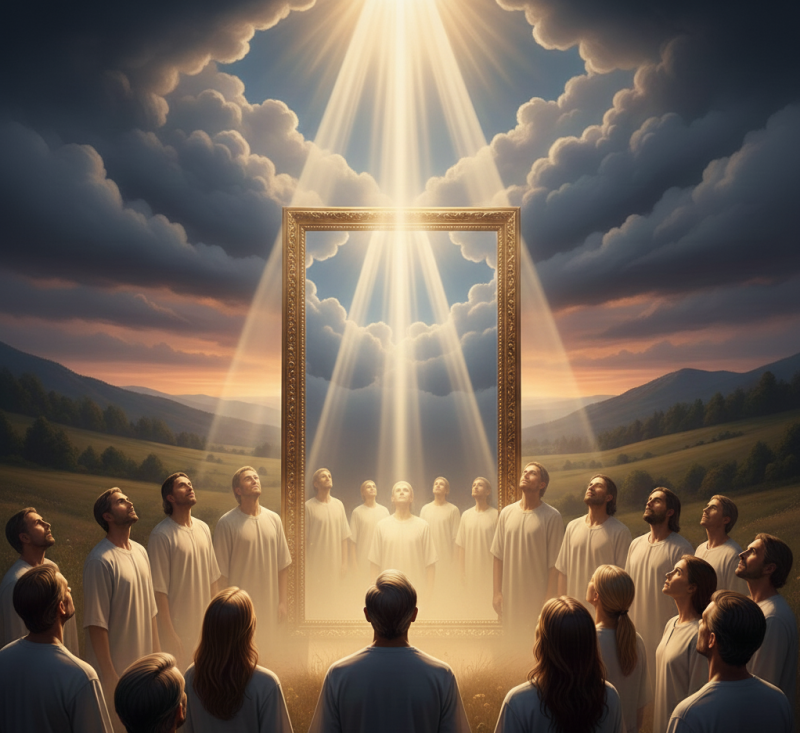
And what does He see then? Not our spots, mistakes, or failures, but the perfect character of Christ.
Because Jesus is sinless and fully perfect, God now sees us as sinless and perfect. Exactly as He made us in the beginning.
- God no longer sees the believer as broken and lacking.
- God sees him through Christ: cleansed, righteous, perfect.
- Not because we are that way ourselves, but because Christ’s perfection is credited to us.
We see this very clearly in the Bible. Paul explains that who we were (with all our faults and brokenness) is “hidden” from God—not because God doesn’t want to see, but because Jesus stands in between. God sees Christ, who “knew no sin,” and therefore sees us as Christ is: clean, pure, and spotless.
“For you have died, and your life is hidden with Christ in God.” (Colossians 3:3, NASB)
“He made Him who knew no sin to be sin on our behalf, so that we might become the righteousness of God in Him.” (2 Corinthians 5:21, NASB)
6. The Bible is also honest about the other side
If someone does not believe who Christ is and what He has done for us, then Jesus does not stand as a “lens” between that person and God. That protective, covering “filter” does not apply. God then sees that person as they really are in this broken world: with sin, shortcomings, and guilt.
This becomes a serious problem. Not because God is harsh, but because He is holy and perfect. His Heaven is perfect. There is no place for sin, injustice, or even the smallest spot. He rightly protects His Heaven, because if He allowed even one single spot, the same misery, pain, and brokenness we see on earth would enter there. God, in His love and justice, simply cannot allow that.
And let’s be honest: would you want Heaven to be as chaotic and full of misery as the earth now? Of course not. We long for a Heaven without all the pain, grief, and brokenness we experience here. And that is exactly why the gospel is such good news: it offers a way to that perfect Heaven through the “lens” that is Christ.
This is exactly why the gospel is “good news.”
God does not leave us to our fate. He does not ask us to cleanse ourselves, because we cannot. Instead, God Himself provided the solution: Jesus Christ, who stands as a perfect “lens” between Him and us. Through Christ, God does not see our sins, but the perfection of Jesus.
And all we have to do to fall under that covering is believe who Christ is and what He has done for us.
- No extra work.
- No performance.
- No religious ladder.
- Just faith. This is the essence of grace: nothing more, nothing less.
7. Summary
- Half-truths are misleading: saying only that humans are bad or good does not give the full picture.
- Originally good: God created humans with value and purpose (Genesis 1:31).
- The world and humans no longer function perfectly: all fall short of God’s intended goal (Romans 3:10–12, 23).
- Sin = missing the mark: a fundamental rupture in relationship with God.
- Diagnosis: naming sin shows there is a problem, like a doctor diagnosing a disease.
- Restoration is possible through Christ: Jesus stands as a perfect “lens” between God and us, so God sees us not as we are now, but as He intended.
- The problem without Christ: unbelievers stand without this covering before God and are seen as broken and sinful. This is serious because God is perfect, and His Heaven cannot allow the slightest flaw or sin.
- New perspective through faith: believers are seen by God as renewed and justified (2 Corinthians 5:17, 21). Through Christ, we see a Heaven without pain and misery, exactly as God intended.
- Effort required: both questioner and answerer must be willing to hear and understand the full story, otherwise one remains stuck with half-truths.
Thus, the Bible honestly acknowledges the reality of the world and humanity, while simultaneously offering hope: sin is not the final word; forgiveness and restoration through Christ are.