Tech, Teams, and Dedication: Working for God Requires Our Best

Last week we got to give a joint sound tech training for a bunch of churches and Christian music groups. On the surface, the topic seemed simple: how to set up a stage, what tech can solve, and what it never can. But during the training, deeper questions came up—questions way beyond cables and microphones.
Right from the start, it was clear that having a biblical foundation is crucial for everything that follows:
“For which one of you, when he wants to build a tower, does not first sit down and calculate the cost, to see if he has enough to complete it? Otherwise, when he has laid a foundation and is not able to finish, all who observe it begin to ridicule him.” (Luke 14:28–30, NASB)
“The plans of the diligent lead surely to abundance, but everyone who is hasty comes only to poverty.” (Proverbs 21:5, NASB)
“Do not be slothful in zeal, be fervent in spirit, serve the Lord.” (Romans 12:11, NASB)
These verses set the stage: if you want to build well, you need to plan, be diligent, and serve God with passion. Everything else—tech, music, stage setup—only bears fruit if this biblical framework is applied.
The exercise: chaos on stage
The exercise was simple: look at this practice stage and spot the mistakes.
Cables were a mess, microphones scattered everywhere—the solutions were obvious.
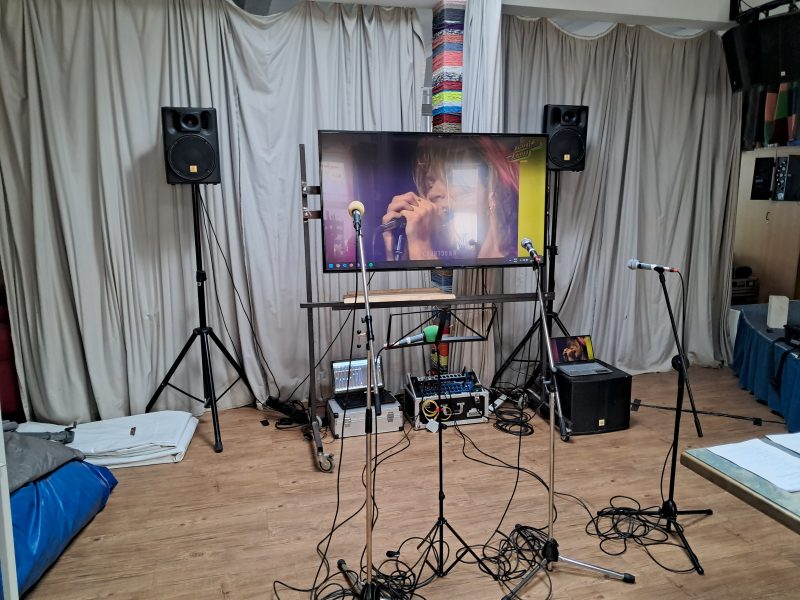
Then came the question:
If you want to set up a stage safely and properly, do you start only when the musicians arrive?
Of course not. Preparation happens beforehand. But that only works if you know at least a day in advance who’s coming and what instruments they’re bringing. If that info comes in last minute, chaos is inevitable: rushed connections, things not working, frustrations.
Being “flexible”?
A common problem we heard from participants that day was, “You have to be flexible.” And many weren’t comfortable with that. Often, it was used as an excuse to cover for someone else’s lack of preparation. Someone has to be flexible and clean up another person’s mess. That’s not flexibility—that’s stress, frustration, chaos, and often spiritual abuse.
The Bible gives clear guidance here:
“Bear one another’s burdens, and thus fulfill the law of Christ… For each one will carry his own load.” (Galatians 6:2,5, NASB)
“So then each one of us will give an account of himself to God.” (Romans 14:12, NASB)
Flexibility only works if the foundation is solid: authority, resources, and clear agreements. You can support each other in love, but you’re not called to take on someone else’s negligence or chaos. Everyone carries their own load and gives an account to God.
Responsibility and authority go together
The same applies to music and the service itself. Techs can’t be held responsible for the theme of the service or the mood the music should create. That’s up to the pastor or leadership. Without that info, the tech can’t do their job well.
Sometimes people would say, “We’re all responsible, right?” But that’s often misused to dodge personal responsibility. The Bible makes it clear: responsibility is tied to your own tasks and mandate:
“Bear one another’s burdens, and thus fulfill the law of Christ. For each one will carry his own load.” (Galatians 6:2,5, NASB)
“So then each one of us will give an account of himself to God.” (Romans 14:12, NASB)
“But the one who is trustworthy in very little is also trustworthy in much, and the one who is dishonest in very little is also dishonest in much.” (Luke 12:48, NASB)
💡 Application:
Yes, we work together as a team, but everyone has their own role and responsibility. I (whether I’m a musician or a tech) can’t make the choices of the pastor. Galatians 6:5, Romans 14:12, and Luke 12:48 make it clear: each person carries their own load, gives an account to God, and is personally responsible for what’s entrusted to them. So “we’re all responsible” is no excuse to dodge responsibility—or pass it off chaotically to someone else.
Take background or entrance music, for example. You want people to enter quietly and prepare their hearts. The music must fit the theme of the service—joyful for a celebration, solemn for a memorial. But the tech can’t decide that. It’s the pastor or liturgy team’s responsibility to communicate what’s needed in advance (what type of music, which songs, playlist). Only then can the tech make sure everything works technically.
The same goes for soundcheck and setup: without the right tools, authority, and preparation, sound quality can never be optimal. Responsibility without authority is a lost battle.
During the training, some participants admitted they sometimes wanted to quit or pull back—simply because the right framework was missing: preparation, authority, and resources. That’s painful to hear.
Hierarchy of responsibility (who serves whom)
Goal: clarify who has authority, who leads, and who gives an account.
- 1: God – center and ultimate team leader. Everyone serves Him.
- 2: Pastor / Minister – serves God, leads the team, sets the framework, decides theme, mood, and order.
- 3a. Worship leader – serves pastor and team, leads music in line with the theme.
- 3b. Techs – serve pastor, worship leader, and team, ensure technical execution goes smoothly.
(Example: techs often start setup only when musicians arrive, because they weren’t given authority or info to start earlier. Result: rushed connections, tangled cables, wrong mic placements, frustration, delays. No matter how hard techs try, without clear framework, authority, and prep time, no one can run a flawless service. Responsibility without authority always leads to chaos.) - 4: Attendees – served by the team, serve God through participation, serve each other through engagement.
Principle: responsibility follows authority. Everyone gives an account to God for their own task (Galatians 6:5, Romans 14:12, Luke 12:48).
Hierarchy of purpose or impact (who benefits most)
Goal: show who everything is ultimately for.
- 1: God – everything is done for His glory and to serve Him.
- 2: Attendees – recipients of the message, worship, and guidance; their experience and spiritual growth are the direct goal.
(Example: musicians sometimes pick too many new songs the congregation doesn’t know. If people don’t know the songs, it’s almost impossible to sing together; it becomes a performance instead of corporate worship. No matter how beautiful the performance, it doesn’t serve the congregation. Congregational singing works only when attendees actively participate and God is praised together.) - 3: Pastor / Minister – ensures the message and worship reach attendees, serves God and the team.
- 4a. Worship leader – enhances attendees’ experience through music fitting the theme and mood.
- 4b. Techs – ensure optimal execution so the message comes through without distraction.
Clear: God is always number one, in both responsibility and purpose. The difference between hierarchies shows that authority and impact aren’t always in the same place, but all work together for God’s glory.
The key question: who are we doing this for?
Why are we on stage? For ourselves? For the audience? Or to serve God?
The Bible is clear:
“And whatever you do, in word or deed, do everything in the name of the Lord Jesus, giving thanks to God the Father through Him.” (Colossians 3:17, NASB)
“Unless the LORD builds the house, they labor in vain who build it.” (Psalm 127:1, NASB)
“Whether, then, you eat or drink or whatever you do, do all to the glory of God.” (1 Corinthians 10:31, NASB)
When God is number one, everything changes. Then preparation becomes essential. Then we don’t rehearse “just quickly” before the service, but take time during the week to rehearse thoroughly. Then we pick music that fits the theme, prepare the sermon carefully, and build the stage well in advance. Working for God demands our very best—100%, not 40%.
Group or team?
What’s the difference?
- Group: individuals standing side by side, without a common goal.
- Team: people working together, each with their own role, focused on one goal, supporting each other.
The Bible encourages real teamwork:
“And let us consider how to stimulate one another to love and good deeds, not forsaking our own assembling together, as is the habit of some, but encouraging one another; and all the more as you see the day drawing near.” (Hebrews 10:24–25, NASB)
That’s the heart of teamwork in the church: support each other, encourage each other, and remember we do this together—for God.
In church, we’re not isolated individuals but a team under one leader: Christ himself. If He’s our team leader, our attitude changes. We don’t work for our ego, but for His glory.
Personal note
After years of experience with different (even commercial) bands and churches, I can spot the difference quickly. Sometimes I feel embarrassed by the chaos, half-hearted effort, and improvised soundchecks: “Quick, quick, throw it together and go.” It makes me more selective about where I commit. If we’re putting in effort, I want it to really count—so we can say we gave our very best, to God’s glory.
That’s why this training was so valuable. Some teams took responsibility seriously, wanted to learn, and genuinely wanted God first. That gives hope.
Conclusion
The question remains: do we go for convenience and half-hearted effort, or do we commit fully as a team, with preparation, authority, and resources—all for God’s glory?
Everything we do—tech, music, setup—requires preparation, diligence, and dedication. And it only matters if God is the center. Then every detail, from soundcheck to background music, becomes a shared service to Him.
(And yes, we also talked about microphones, mixers, cables, and all the technical stuff—but if the foundation isn’t right, it doesn’t make much difference. Tech can’t hide a shaky foundation.)


