God and “His” PTSD.

I spoke with X a while ago and he was struggling quite a bit with his PTSD. What is that? PTSD (Post-Traumatic Stress Disorder) arises as a reaction to a severe traumatic event. This can include, for example, a traffic accident, sexual violence, abuse, war experiences, natural disasters, or other life-threatening situations.
And where do you notice that, in your “normal” life? PTSD is characterized by four main groups of symptoms:
1: Re-experiencing: Flashbacks or nightmares about the trauma Sudden fear or panic due to memories As if the event is happening again
2: Avoidance: Avoiding people, places, or conversations that remind one of the trauma Inability to talk about the trauma Emotional numbing or distancing from others
3: Negative changes in mood and cognition: Sadness, guilt, shame Feeling of alienation or detachment Loss of interest in life Concentration problems or memory loss surrounding the trauma
4: Increased irritability: Being easily startled or having angry outbursts, Sleep problems, Constantly being alert (hypervigilance), Self-destructive behavior (such as substance abuse)
And what X wanted to talk about this time is his being easily startled or having angry outbursts. In this case, the startle came from a fellow road user who cut him off, and he consequently had an angry outburst, and that went completely, absolutely wrong. “Things started flying through the air” and more… The intense angry outbursts in people with PTSD are not ordinary anger; they are usually an automatic survival response from a brain that is constantly on high alert. In PTSD, the part of the brain that signals threat—the amygdala—is hyperactive. It overreacts to stimuli, even if they are not truly life-threatening. The body reacts, fully automatically, as if it is being attacked and it is truly(!) life-threatening. The prefrontal cortex (which normally inhibits impulses and thinks things through) functions less effectively in PTSD. As a result, a small trigger suddenly escalates into an explosion of anger, emotions are less well controlled, and the ability to put things into perspective in the moment is lacking. This was also the case with X. And there’s something else:
Many people with PTSD have years of suppressed emotions (such as fear, pain, sadness, or shame). Anger is then sometimes the only way that built-up tension is released. Those pent-up emotions, which he also had at other times but held back, then burst out all at once. So not only the emotions of that one moment, but also everything that was already contained from the past seems to suddenly come out. Let’s put it this way… it literally becomes explosive.
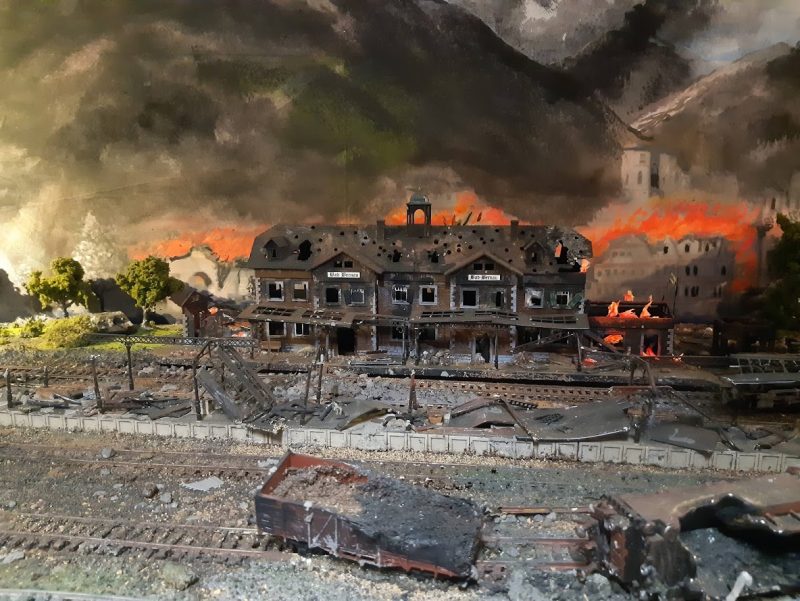
What you see in that picture, also happens in his head at that moment, and what comes out often quickly looks like that.
But alright, how do you deal with that, because that’s a very difficult issue. The anger X has is not the anger most readers know, because you still have a well-functioning “amygdala.” X doesn’t, so X literally has a handicap that you don’t see from the outside, but it’s there.
As soon as you would say “Just act normal,” “You’re exaggerating,” “Everyone gets angry sometimes,” or for example, “You just need to control yourself,” it’s the same as telling someone with one leg that they can just participate in the Rotterdam marathon and shouldn’t make a fuss. How would such a person with one leg react? If you say something like “Act normal” or “You’re exaggerating” to someone with PTSD—especially someone struggling with angry outbursts—it can turn out very destructively. (see picture…) They might then, due to your reaction against someone with one leg, burst into anger—shouting, reacting aggressively, or breaking things.
Not because they are ‘picky,’ but because the brain perceives it as an attack or humiliation. They then enter a survival reflex: fighting instead of fleeing or freezing. And who causes that? You and your reaction. Because there’s nothing they can do about their handicap, just like missing a leg.
What X can do something about? His reaction, but yes… easier said than done, because how do you do that? He indicated that he now constantly tries to run away from “fights,” but he was also struggling with that. Because constantly (literally, in his feeling) literally fleeing is complicated. If you’re on the run your whole life, even from yourself, how would that feel for you? We then looked at the following Bible verses:
Matthew 22:36 “Teacher, which is the great commandment in the Law?” 37 And He said to him, “‘You shall love the Lord your God with all your heart, and with all your soul, and with all your mind.’ 38 This is the great and foremost commandment. 39 The second is like it, ‘You shall love your neighbor as yourself.’ 40 Upon these two commandments hang the whole Law and the Prophets.”
The first question I asked him was who you should love according to that verse. And his answer was fitting for someone with PTSD:
God and my neighbor.
And something was missing in his answer… Himself.
as yourself
To love your neighbor, you must first love yourself. And that is a problem for X. One of the characteristics of someone with PTSD is: Sadness, guilt, shame, loss of interest in life, feeling of alienation or detachment. So, loving yourself… phew, that’s difficult! His first “dive” attempt was therefore immediately:
No, I’m not allowed to, because God is above everything and I’m not allowed to be selfish.
Do you see the nuanced differences in his thinking and in the thinking of a healthy person? Yes, I completely agree, God MUST be number 1, but after that, you need to know how to love yourself (2a), and your partner (2b) so that you also know how to love your neighbor. If that sequence isn’t right, then loving your neighbor will also continuously fail.
Once we had concluded that part, we started to look at what you (according to the Bible) should do if you are life-threateningly threatened. Because yes… that fleeing… is that really good?
Ephesians 6:11-18: Put on the full armor of God, so that you will be able to stand firm against the schemes of the devil. For our struggle is not against flesh and blood, but against the rulers, against the powers, against the world forces of this darkness, against the spiritual forces of wickedness in the heavenly places. Therefore, take up the full armor of God, so that you will be able to resist in the evil day, and having done everything, to stand firm.
Stand firm therefore, having girded your loins with truth, and having put on the breastplate of righteousness, and having shod your feet with the preparation of the gospel of peace; in addition to all, taking up the shield of faith with which you will be able to extinguish all the flaming arrows of the evil one. And take the helmet of salvation, and the sword of the Spirit, which is the word of God. With all prayer and petition pray at all times in the Spirit, and with this in view, be on the alert with all perseverance and petition for all the saints,
There are 6 things you must use:
Helmet (defensive)
Belt (defensive)
Sword (offensive)
Breastplate (defensive)
Shield (defensive)
Sandals (defensive)
Do you notice it now? Only 1 of those things is offensive.. the rest, all(!) the other 5: defensive! In other words, him running away, and (as he himself said), running, running and running… his whole life long… that is therefore not wrong. And what if you do have to attack?
the sword of the Spirit, which is the word of God
In other words, if you do have to attack, use God’s Word, the Bible, and not your own strength or powerlessness… or anger. Easier said than done, but how then? I gave him an example that often helps me.. Do you know who else can be FURIOUS? God.
Romans 1:18: For the wrath of God is revealed from heaven against all ungodliness and unrighteousness of people who suppress the truth in unrighteousness,
And yes… God is also merciful, but God also… now that He is merciful, builds up His wrath.. and that will come out eventually:
Romans 2:4-6: Or do you think lightly of the riches of His kindness and tolerance and patience, not knowing that God’s kindness is intended to lead you to repentance? But because of your stubbornness and unrepentant heart you are storing up wrath for yourself in the day of wrath and revelation of the righteous judgment of God, who will repay each person according to his deeds:
Wow! And no, God does not have PTSD (because God is perfect and cannot have a handicap), but do you see that there’s something in it that X also feels when he explodes? Here you see a positive promise… but if you read a little further.. also a chilling promise:
2 Peter 3:9-10: The Lord is not slow about His promise, as some count slowness, but is patient toward you, not wishing for any to perish but for all to come to repentance. But the day of the Lord will come like a thief, in which the heavens will pass away with a roar and the elements will be destroyed with intense heat, and the earth and its works will be discovered.
Hebrews 10:26-27: For if we go on sinning willfully after receiving the knowledge of the truth, there no longer remains a sacrifice for sins, but a terrifying expectation of judgment and the fury of a fire which will consume the adversaries.
Wow… and then if you get cut off in traffic and understand that that person has harmed you, a child of God… and then you see this verse:
Romans 12:19: Never take your own revenge, beloved, but leave room for the wrath of God, for it is written: “Vengeance is Mine, I will repay,” says the Lord.
Wow again… And X understood that. His PTSD anger is NOTHING compared to God’s anger at all the injustice in this world.. And if you understand that, and you get cut off in traffic again and understand what God thinks about it… that might prevent you from exploding next time, but instead to be merciful and say the same thing that Christ did and said to His Father:
Luke 23:34: But Jesus was saying, “Father, forgive them; for they do not know what they are doing.”
Jesus asks God for mercy for the people who nailed Him to the cross, because Jesus knows The Father and knows how FURIOUS His Father can become.
Try, in moments when things threaten to go wrong, to put on your Helmet (defensive), Belt (defensive), Breastplate (defensive), Shield (defensive) or your Sandals (defensive) and run, run, run and pray, pray, pray for God’s mercy, because His sword… that is offensive…
Lord, have mercy on us.
I hope and pray this helps X. He concluded the conversation with the following words:
I don’t think it’s a coincidence that we had contact today. God chose you to speak to me. I praise Him on my knees, with gold and tears in my eyes. You made me smile. For many perhaps a small thing, but for me it is something great. Thank you. God bless you. It’s simply nice to know that I’m not the only one struggling with PTSD!!!!
And what can you, as a reader, do with this? If you know someone with PTSD or now suddenly think… “hey, I know someone with those symptoms,” then think VERY carefully about how you treat that person and what you say to him/her next time things go wrong. Because telling someone that they “shouldn’t make a fuss with their one leg and can just run the marathon”… is A not fair and B is counterproductive… Take someone’s handicap into account so that it doesn’t get worse.