Evangelism: aftercare.
As you saw in part 1, there is quite some work involved before we start a conversation and once the conversation (see part 2) has started, there is also quite some work to do. And when that conversation is over. What’s next? Do we let them go, or what do we do?
As you have already seen in parts 1 and 2, God is the moderator in all conversations. It is up to Him before the conversation starts, it is up to Him what happens during a conversation, and it is also up to Him what happens afterward. That gives us peace because He is in control when we are not. If we didn’t allow all conversations to take place in this way, we would go crazy very, rapidly. So, not only before and during the conversations, but also after that time. And that is the right start for aftercare. (in any way or form)
With only a “we pray for you” or “we leave it to God” we are not there yet because the Bible also clearly says: (and this is just one example)
Suppose a brother or a sister is without clothes and daily food. If one of you says to them, “Go in peace; keep warm and well fed,” but does nothing about their physical needs, what good is it?
James 2:15-16
And with mental needs, it works the same as with physical needs. Only praying for the other person is not the way to go, so aftercare is also needed.
A form of aftercare that we do ourselves, for example, could be that that person continues to visit us for periodic conversations for a year (or even longer). That could be once a week, several times or a few times a week… just name it. So we never just let anyone “swim”. If these conversations cannot be held at our location, they can also be done remotely because fortunately the world has become a lot smaller with the internet. This also means that the threshold for aftercare has become smaller, and we are therefore happy to take advantage of that.
Another example could be that someone came to God through Christ! (John 14:6) Beautiful! It is beautiful to see God’s family grow through conversion. There’s a kind of momentum and excitement when that happens, every single time. But it is also a dangerous moment. Huh, say what? Note: It is easy for them to slip away… to “freeze” that new faith… to not move on and to slide again. Then it seems that you have a “profit”, but if you look at it honestly, it is not a profit…. The first figures may seem nice, but there can be a huge difference between gross and net… And we want to avoid that at all costs.
Just as a newborn baby must continue to grow after birth, new believers must continue to grow in faith, wisdom, and holiness to become more like Jesus (2 Peter 3:18).
But grow in the grace and knowledge of our Lord and Savior Jesus Christ. To him be glory both now and forever! Amen.
2 Peter 3:18
If a baby doesn’t grow after birth, something is wrong. Every birth results in growth. We grow at different rates and in different ways, but growth is evidence of life. So you have to keep an eye on that growth and continue to do so. And since we do not live all over the world and cannot be everywhere at once, God has invented something very beautiful for that purpose: the church. Because, please note:
not giving up meeting together, as some are in the habit of doing, but encouraging one another—and all the more as you see the Day approaching.
Hebrews 10:25
In other words, we must continue to “encourage and warn each other in our meetings” to ensure that spiritual growth and to get to know our Lord and Savior Jesus Christ better and better. In other words, when we see that someone comes to God through Christ, that person must quickly, very quickly, find a connection with a church or community somewhere. Preferably today.
A problem we always have is that we don’t live everywhere (and the people we talk to come from all over the world) and so we can’t just take them to “our” church. Another problem is that “our church” may not exist at all in the area where they live. As you have already seen in the previous parts of this explanation, only 0.35% of the people in the country where we now work are Protestant Christians, so good luck finding “our” church here. It simply isn’t there. And if there is one “in name” you will be surprised at how much it differs from what you know from your own home country. The nameplate may be the same, but the way they “run church” can be entirely different. So we are also cautious to rely on a “name tag”. Because unfortunately, there are also many buildings that call themselves churches, but are not… However, we do have a kind of list that should in principle be good for denominations and also a list where we (unfortunately) certainly cannot send someone. So we do have a generic direction and a list of churches and congregations that should be reliable.
And again, it is up to God before the conversation started, it is up to Him what happens during a conversation, and it is also up to Him what happens afterward. That gives us peace because He is in control when we are not.
But how do you get someone to take that step themselves because we cannot take that step for that person. Below is an example of what we can do… (and there are several more things of course, this is just one example)
Suppose (this is simply one example) someone has experienced something that was far from pleasant. Something happened that really hurt someone.
We have these conversations several times with different people per week, so that is almost standard for us. The great thing is that stunning conversations often arise from that oppression and someone understands that he himself can never be the solution, neither can we, but that he needs God for the solution.
It goes one step further when someone understands that the problems we experience in this life are the result of our own choices we have made (Adam, Eve, “apple”, tree, snake, sin) and that we to bear the consequences today. (thorns, thistles) It goes even further when someone understands that we actually deserved death (right then), but that by God’s grace we have been given a second chance through Christ! And yes, that may mean that we may have a huge problem in our lives today, but if we believe that Christ died for us, an eternal future awaits us without all this misery. If someone really believes that (and we really check that because there is nothing scarier than a false Christian who thinks he is a Christian, but isn’t…) there’s a party! Well, yes, there is a party, but usually something else too…
Those thorns and thistles will remain as long as we are here on earth. And if someone has come to God through Christ, the pain of what happened in the past does not immediately go away. The pain will feel different, it will also be different because it will have a place with God. That is enormously liberating and can also lead to forgiveness for what someone else has done to you. But yes, forgiveness sounds easy, but let’s be honest… it’s not that easy, right? A method that I sometimes use is the following:
- Write a very (!) honest letter to God (and depending on the situation, also to the person who hurt you so much) with all your past pain in it and that you may now also be struggling how-to forgive the other person with God’s help.
- Write that letter to God with a real pen and on real paper. Not on the computer, but take the time and literally write it down. Wonderfully “old-school”.
- Let that letter to God be as honest as possible. Yes, that letter may also be tough and have ragged edges (proverbially) because God wants to hear how you are really doing, what has hurt you. Everything is allowed, feel free. However, God is also a Holy God, to treat Him with the honor that He deserves while writing.
- If anyone knows what pain is, it’s Jesus. He had not eaten “that apple”, was perfect, without sin, but he did receive the punishment for all that sin of you and me. That really hurts, so please describe all your pain, because Jesus will not be shocked by it, but will recognize it. God is the only one who really understands you, so feel free about that too.
- Make 2 copies of that letter. The original remains yours, and please keep it safe. The original remains yours.
- Now pray your socks off for 2 days. Not “just for a moment”, but really: pray! Ask for God’s help for the next steps. You desperately need that Holy help, so ask for that help too.
- Take the first copy to a good church, in a sealed envelope. If you already have a good church that you go to, go there and give them that envelope and do ask them this: DO NOT open this letter, just pray very, very hard about it this week. And then you don’t start the conversation, but tell them that you will come back in a week and talk to them about the content. But again: they are not allowed to open that letter, but they must really pray about it during the coming week.
- Now (if applicable, optional) take the 2nd copy to the person who hurt you so much. If that “in person” is too painful, post is fine too. And yes, that person will read that letter. But since you have already asked God for His help in your prayer, you no longer go alone, but God accompanies you in these steps. Whatever the outcome, trust God’s plan. He knows what needs to be done (or not) and trust that.
- After one week, keep your promise, go to the church where you dropped off that first copy, and open the letter with them and talk about it together.
- And then…trust God. End of story.
And that approach works well! A number of things will happen during the above steps. Examples can include:
- There is (perhaps for the first time in someone’s life) an honest, open connection with God through that letter. An honest conversation, without mincing words, without playing “games”, without masks. That gives space.
- Because it is an old-fashioned on paper letter, someone really has to take the time to think about it and you, together with God, really think about it for a moment. Taking time is important to process things. That gives space.
- You also think cautiously about the pain that Jesus had because of you and my sins. So Jesus’ sacrifice was much greater than the pain you feel now. Wow! Then His Sacrifice was also enormous! Something to think about.
- Yes, the others have a copy of your letter, but the real letter with the real pain in it, with the real ink with your tears, is yours. That paper contains quite a lot of feelings, and you can later choose to bury that letter, burn it, frame it, whatever. This makes your sadness really tangible, and we can do something with it later to process it further.
- There really was time for prayer. Ditto, perhaps for the first time in your life. Philippians 4:6-7 says beautifully what that does:
Do not be anxious about anything, but in everything by prayer and pleading with thanksgiving let your requests be made known to God. And the peace of God, which surpasses all comprehension, will guard your hearts and minds in Christ Jesus.
Philippians 4:6-7
- A connection opens to a church. Perhaps it is the first time that someone has seen a church from the inside, but now there is a connection. The first step cautiously, give a letter, a brief explanation and then leave. The threshold is therefore low, the connection high.
- The church that receives this letter may be quite shocked by this approach, they immediately smell that something is terribly wrong, so they will certainly pray for that person.
- This letter campaign may now have given you a last chance to have one last conversation with the person who did you wrong. You give that person that opportunity, and it is now up to the other person to take it. (or not) You have now done everything you could and with that, you can close another bad chapter, or it opens an opportunity for a beautiful, healing chapter. Opportunities! And whatever comes out, you can’t lose.
- After a week you really start a conversation with a church / community and there is also a deeper connection. This has opened a nice path where both parties can continue to move from baby milk to solid food.
And with this, we also create a different path after a conversation if we cannot be there ourselves. (different country, different culture, you name it) Why?
For everyone who partakes only of milk is unacquainted with the word of righteousness, for he is an infant. But solid food is for the mature, who because of practice have their senses trained to distinguish between good and evil.
Hebrews 5:13-14
Because we may have been able to help someone with the first steps (milk), but as mentioned, we want to move on to solid food as quickly as possible so that someone can grow up into a mature Christian.
And with that, we come to the end of this series, and you may have noticed something else: what a huge mountain of words, research, time, effort and (for you as a reader) reading time it took. NB:
- The piece about the preparation before we even start a conversation, combined with what we don’t do, was +/- 2750 words long.
- The part about how a conversation works was +/- 1171 words long.
- This section about aftercare was +/- 2909 words long.
And that also says something…. A conversation alone is not enough. Before and after that time, there is still at least as much work / time / thinking involved. Even more than the conversation itself! And we have to because we don’t want to “just do something”, but try to deliver 110% quality for God. The preparations, aftercare and safeguarding are the largest parts.
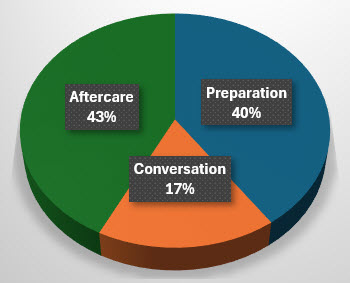
And when you have read everything, you have also seen that they are never “just like that, just conversations”. Only explaining very, very roughly how that works took us +/- 6830 words further. We are also 11 Bible verses further because God determines what we do, and we also check it with His word as a guide. And then we tried to keep it as brief as possible. So our conversations are never “just a conversation”. They also take quite a lot of time because we do not want to tell half a story, half a gospel (with all the misery that can result from that), but the whole story. Because that whole story is important and has eternal value. And that is more than worth the time, words, effort and money.
Go, therefore, and make disciples of all the nations, baptizing them in the name of the Father and the Son and the Holy Spirit, teaching them to follow all that I commanded you; and behold, I am with you always, to the end of the age.
Matthew 28:19-20
Ps. The above is just one example of how we can approach things on this side with the calling we have and with the gifts we have been given. Since E’s gifts are different from M’s gifts, the approach is sometimes also different. Let alone for you as a reader, you have been given different gifts and a different calling than us and so your approach will also have to match your own calling and gifts that you have been given. With the above we try to get everyone to think: how would I approach it, as efficiently as possible, with the calling and the gifts that I have been given? Not for my own honor and glory, but for God’s honor and glory for who you are working for.