How “propaganda” shapes our thinking and why we sometimes choose to stay silent
In our daily work, we regularly encounter propaganda. Not in the dramatic sense of the word, but simply as the way information is presented with a certain bias. What you or I hear in the news, is that really neutral? Or does it unconsciously convey a particular worldview?
That worldview influences us more than we often realize. It shapes how we look at events, how we judge people, and how we interact with the world around us. What is presented as truth in the Netherlands can result in a very different story in another country like Russia, Ukraine, Germany, or anywhere else, about the exact same event.
In our conversations with our target groups, we try to remain as neutral as possible. Not because we have no opinion, but because we realize that we too are shaped by the news we consume. And whether that news is accurate? Honestly, sometimes we just don’t know. That is why we consciously avoid some topics or leave them open, precisely to make room for the other person’s story.
But how exactly does this influence on our thinking through culture and information work? To illustrate this, let us take an example from the past, an innocent-looking children’s game in the former GDR. An example that shows how deeply propaganda can penetrate, even into something as simple as choosing between cowboy or Indian.
Ask a child today to play cowboy and Indian, and you will probably get a smile or a puzzled look: “What is that?” But for those who grew up in the 1970s or 1980s, it was a classic role-playing game.
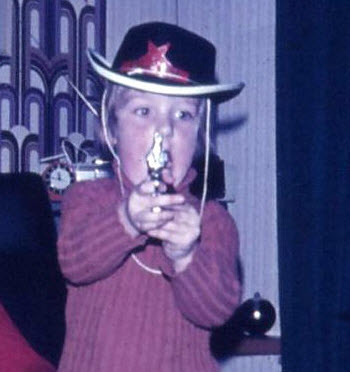
In the West, most children wanted to be the cowboy, the hero with a hat, lasso, and revolver. (That little boy in the picture is me.)
In the GDR, socialist East Germany, it was exactly the opposite. There, children overwhelmingly wanted to be the Indian. Why?
Because in the GDR it was not just a game, but a politically charged choice. In a society where ideology penetrated deeply into education, art, and even children’s games, the Indians became the symbol of the righteous struggle against capitalist oppression. What started as a playground adventure became a mirror of the worldview the state wanted to convey.
The Indian as revolutionary: In the GDR, Native Americans (the “Indians”) were not portrayed as wild or exotic figures, as often happened in the West. On the contrary, they were depicted as noble fighters, victims of colonialism and exploitation, primarily by the United States. They fit perfectly into the communist narrative of the oppressed class: peoples resisting the domination of capitalist powers. By identifying with the Indian, children chose a side of justice, solidarity, and resistance. Precisely the values the GDR wanted to instill in its citizens.
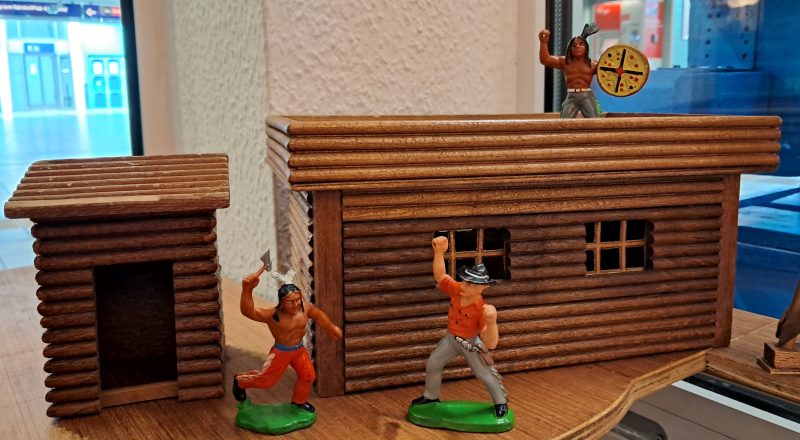
Film as ideological education: The GDR produced its own western films, the so-called “Indianerfilme.” The hero in these films was rarely a cowboy, but almost always a brave Indian, often played by Gojko Mitić. His characters were strong, wise, connected to nature, and loyal to their community. The enemy? Usually from the West: American soldiers, colonists, or entrepreneurs, driven by greed and racism. The contrast was clear and intended as a lesson: the collective versus individualism, noble resistance versus imperialist oppression.
Children’s play as ideological role-play: Even in spontaneous children’s games, state ideology could be heard. On the playground, the cowboy was rarely chosen, because he represented the enemy. Being an Indian meant standing on the right side of history. Play thus became an exercise in worldview: who are you, and whose side are you on? The GDR even used children’s play as a subtle educational tool. Children learned, through play, that solidarity, fighting injustice, and loyalty to the collective were higher values than the romantic individualism of cowboy heroes from the West.
Looking back at those East German children running proudly as Indians across the schoolyard, we see not only costume fun, but also a small piece of history.
A game with a message: The Wall has fallen, the GDR is history, and the game “Cowboys and Indians” is now rare on playgrounds. But the principle remains relevant: even seemingly innocent children’s games are shaped by the worldview in which children grow up. What they play, and how they play it, often reflects deeper convictions, experiences, and stories.
In our work as missionaries and aid workers in eastern Germany, we see daily how that upbringing continues to influence adults’ lives. Not only people who grew up in the GDR, but also Russians, Ukrainians, and others we work with. Each carries their own history, expectations, and tensions, sometimes openly, sometimes hidden beneath the surface.
That is precisely why listening is so important. Making space for the other person’s story. Not filling in too quickly, but asking questions. Showing understanding. Only then does genuine encounter, real healing, and perhaps even some reconciliation in a world full of contrasts become possible.