A common misconception: Heaven as the final destination.
Many people I speak with long for heaven, where they will be forever. Many people, both inside and outside the church, think that heaven is the final destination for Christians after death. The image of “going to heaven” is so deeply embedded in our culture that it has almost become synonymous with the Christian hope. However, something is not quite right when people say that to me, because that is not the whole story. Let me try to explain it – it is a “yes, we go to heaven” and a “no, not as we are now as human beings.”
When I was a child, I thought I would go to heaven and spend eternity walking on golden streets or playing a harp in a robe. And honestly… that image didn’t really appeal to me. Because what do you do there, forever, on those golden streets with a harp and a robe? “Praising God,” people would say. Well, “yay,” I didn’t understand that at all. Is that all there is? It seemed rather meaningless to me, to be honest.
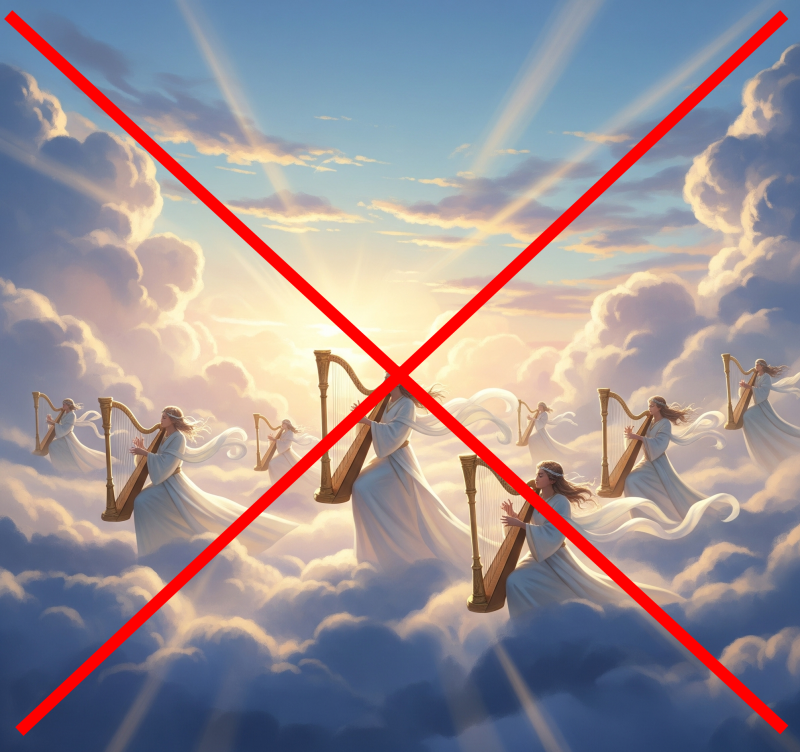
Fortunately, the image I had as a child was not correct… because there is more, MUCH more, something we can truly look forward to. The Bible presents a far richer and greater hope, one that extends beyond heaven alone. Heaven is only a temporary stop, a place of waiting for the ultimate destination: a new heaven and a new earth.
Death and the transition to heaven (the intermediate state)
When a believer dies, their soul leaves the body and they are immediately “with the Lord.” This is the intermediate state, the period between death and the final resurrection. The Bible describes this as a state of consciousness and joy, but not as humans in our current physical bodies – more like “naked” souls or spirits with Christ.
Philippians 1:23 (NASB) “But I am hard-pressed from both directions, having the desire to depart and be with Christ, for that is very much better.”
2 Corinthians 5:8 (NASB) “we are of good courage, I say, and prefer rather to be absent from the body and to be at home with the Lord.”
Consider Luke 23:43, where Jesus says to the thief: “Truly I say to you, today you shall be with Me in Paradise.” Jesus’ post-resurrection appearances also show this: recognizable, yet able to pass through doors and not bound by physical matter (John 20:19–26). These passages emphasize that for a Christian, death is “gain,” because it means being immediately with Christ. This is the comforting aspect of heaven: a paradise of rest and joy. But it is not yet the ultimate destination, and we are not there “as we are now as human beings.”
Accountability before God
We must also give an account before God, which takes place at Christ’s judgment seat in the heavenly realm where God reigns (Romans 14:10–12: “For we will all stand before the judgment seat of God”; 2 Corinthians 5:10: “For we must all appear before the judgment seat of Christ”). This happens before the new earth – a heavenly judgment where believers’ lives are weighed.
P.S. About the purgatory that does not exist. The theory of purgatory, a place where souls are purified after death, is not supported by the Bible. Scripture teaches that our salvation is complete and immediate through Jesus Christ.
Hebrews 10:14 (NASB) “For by one offering He has perfected for all time those who are sanctified.”
Romans 8:1 (NASB) “Therefore there is now no condemnation for those who are in Christ Jesus.”
The second coming and the resurrection of the body
The ultimate hope is not a disembodied existence in heaven, but the resurrection. At Christ’s return, bodies will be transformed and reunited with the soul in a glorified body, suitable for the new creation.
1 Corinthians 15:42–44 (NASB) “So also is the resurrection of the dead. It is sown a perishable body, it is raised an imperishable body… It is sown a natural body, it is raised a spiritual body.”
1 Thessalonians 4:16–17 (NASB) “For the Lord Himself will descend from heaven with a shout… and the dead in Christ will rise first…”
This is an encounter with the King, after which we will return with Him to the earth.
The new heaven and new earth: the final destination
Revelation 21:1–3 (NASB) “Then I saw a new heaven and a new earth… Behold, the tabernacle of God is among men, and He will dwell among them…”
Here heaven and earth are united into a renewed, purified earth without suffering.
What will we do on the new earth?
Isaiah 65:21–22 (NASB) “They will build houses and inhabit them, they will also plant vineyards…”
Revelation 22:5 (NASB) “…and they will reign forever and ever.”
A productive, royal life in harmony with God – building houses, eating fruit, ruling, without sin. And yes, there you can hug polar bears without risk!
Conclusion
The Christian hope is far richer than simply “going to heaven” as is often thought. Heaven is beautiful and temporary, as spirits with God awaiting judgment; the new earth is our eternal home as fully restored human beings. Exactly as God intended it. I can’t wait!